
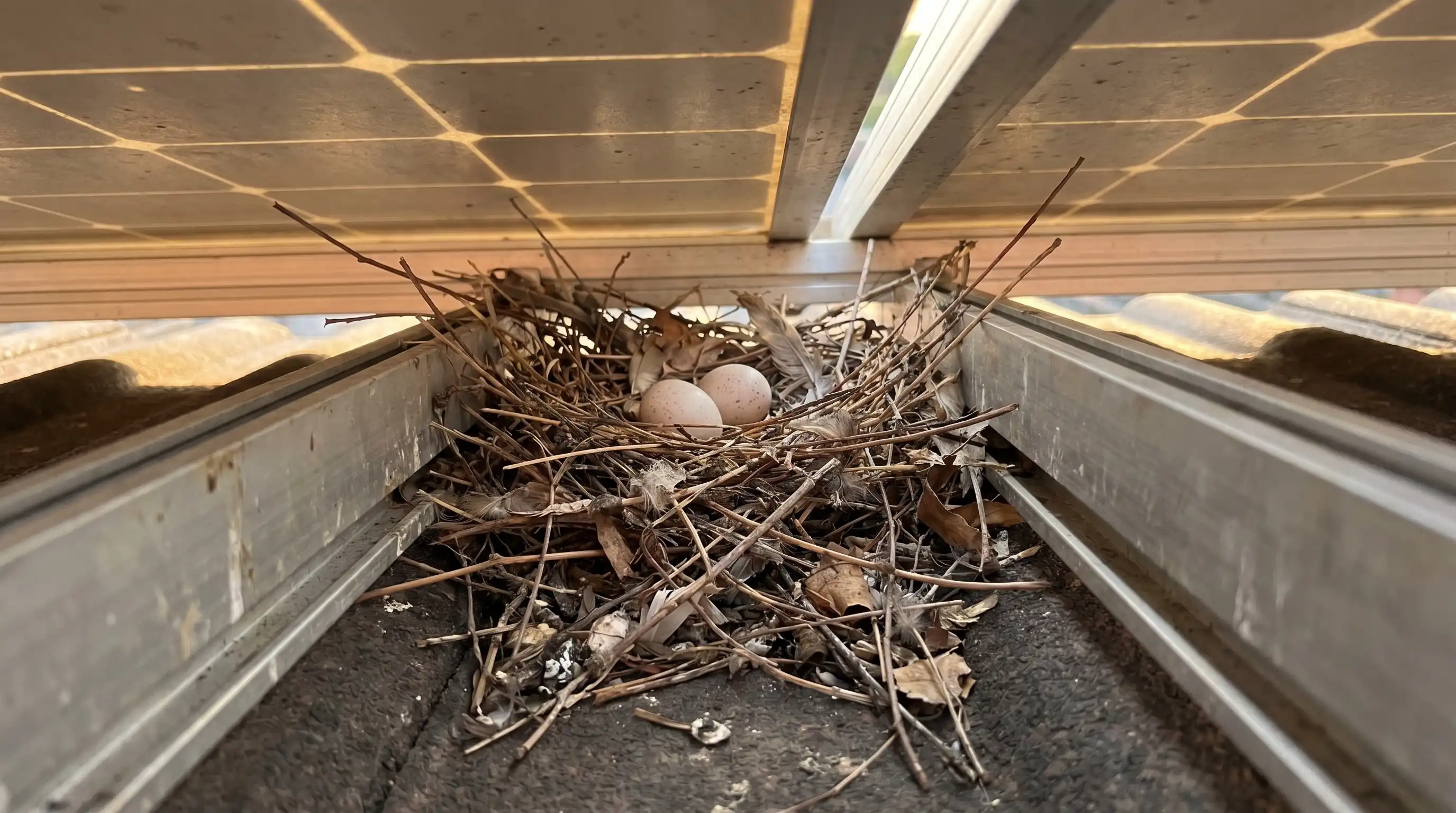
How to Get Rid of Birds Already Nesting Under Your Solar Panels
Stopping birds from moving in is straightforward. Getting them out once they have settled, without breaking NSW law, spreading mites through your roof cavity, or sealing contaminated debris under the panels, is a different job with a different order of operations. This guide covers that order.
Table of contents
- Quick answer
- Nesting or just perching?
- Step 1: Identify the species
- Step 2: Is the nest active?
- Step 3: Plan for the mites
- Step 4: Clean, treat, then seal
- What removal costs
- When it becomes an electrician's job
- Four mistakes to avoid
- Timing through the Sydney year
- What to ask before you book
- FAQs
- Sources
Removing birds already nesting under solar panels
Removing birds already nesting under solar panels takes four steps in a fixed order: identify the species, check whether the nest is active, clear and decontaminate the cavity, then seal the array perimeter with mesh in the same visit. Order matters. In NSW all native birds are protected under the Biodiversity Conservation Act 2016, and sealing a cleared cavity without treating the leftover nest material can push bird mites into your roof space instead of ending the problem.
- Feral pigeons, common mynas, starlings and house sparrows are introduced species and are not protected under the NSW Biodiversity Conservation Act 2016. Native birds are.
- Animal welfare law still applies to every bird. Sealing live young into a cavity is never an acceptable method, protected species or not.
- Bird mites move indoors in the first weeks after young birds leave the nest. Clean-out and mite treatment belong in the same visit as the seal.
- Two things are being priced: variable clean-out and decontamination, plus mesh charged by the linear metre of array perimeter. Ask for both, itemised.
First, confirm they are actually nesting and not just perching
Birds sitting on top of your panels are a nuisance. Birds getting underneath them are a job. The two need different responses, so it is worth being certain which one you have before you call anyone.
Signs that point to nesting rather than perching
- Repeated early-morning cooing, scratching or shuffling directly above a ceiling, usually starting around dawn
- Birds flying low to the roof and disappearing at the panel edge rather than landing on top
- Straw, twigs, feathers or shredded plastic poking out from under the panel frame, or the same material appearing in gutters and downpipes
- Concentrated droppings running down the panel faces and along the roof sheets below the array, rather than scattered spotting
- A sharp rise in gutter debris after rain, particularly if downpipes start backing up
The reliable check is visual, from the ground, with binoculars or a zoomed phone photo taken along the line of the array rather than at it. Nesting material is usually visible at the corners first. Do not climb up to look. Most serious residential roof injuries in Australia happen on exactly this kind of unplanned trip up a ladder, and the view from the edge of the array will not tell you much more than a photo will.
If you are still unsure, a technician can confirm it during a free site assessment, which is standard across Sydney. Scratching in the roof cavity itself, rather than under the panels, is usually a different animal: see possum removal or rodent treatment if the noise is coming from inside the ceiling rather than above it.
Identify the species before anyone touches the roof
This step is not optional and it is not a formality. What you are allowed to do next depends entirely on what is up there.
Which birds are protected in NSW
All native birds are protected in New South Wales under the Biodiversity Conservation Act 2016, and the penalties for harming them are serious. Introduced species do not carry that protection. The NSW code of practice for native birds states plainly that there is no protection for introduced species such as the common myna, because they are not native.
Under Sydney solar arrays, the birds causing the problem are almost always introduced:
| Bird | Status in NSW | How common under Sydney arrays |
|---|---|---|
| Feral pigeon (Columba livia) | Introduced, not protected | Most common by a wide margin |
| Common myna (Indian myna) | Introduced, not protected | Common |
| Common starling | Introduced, not protected | Occasional |
| House sparrow | Introduced, not protected | Occasional |
| Noisy miner and other native birds | Native, protected | Uncommon, but changes everything if present |
Native birds do occasionally use roof spaces and eaves, and if that is what you have, the situation changes completely. You cannot remove them yourself, and a licensed operator will need to work within the wildlife rules rather than around them. We handle protected wildlife the same way on possum jobs, where the animal is protected and exclusion is the only lawful path.
The native lookalike that catches people out
Noisy miner is a native honeyeater and is protected in NSW. Common myna is introduced and is not. They sound almost identical when spoken, they are similar in size, and homeowners mix them up regularly.
- Noisy miner (protected): grey body, black head cap, yellow patch behind the eye.
- Common myna (not protected): brown body, glossy black head, bright yellow skin around the eye, yellow legs.
If a technician cannot tell you which one is on your roof, that is a reason to get a second opinion, not a detail to wave through.
Not protected does not mean anything goes
One thing gets missed in a lot of online advice. The Prevention of Cruelty to Animals Act 1979 (NSW) defines an animal to include birds, and it does not carve out introduced species. So while a feral pigeon is not protected wildlife under the Biodiversity Conservation Act, deliberately sealing live nestlings into a cavity where they will starve is a welfare matter regardless of the species. A competent operator plans around that. It is also simply bad practice, because dead birds under a sealed array produce odour, flies and a second call-out for dead animal removal.
Check whether the nest is active
An active nest holds eggs or dependent young. A vacated nest holds material, droppings and parasites, but no live birds.
This matters more in Sydney than people expect, because feral pigeons do not have a tidy off-season. SA Health notes that pigeons are capable of breeding throughout the year, which is why a reliable food supply nearby keeps a colony productive in any month. The main season runs roughly July to February, but "wait for the season to end" is not a workable plan with pigeons the way it might be with a seasonal nester.
There are three realistic paths from here, and a decent operator will tell you which one applies:
No active nest
Clear, decontaminate and seal in one visit. The cleanest outcome and the fastest.
Active nest, introduced species
Options depend on the stage the young are at and on the operator's licence and methods. A conversation to have with a licensed technician, not something to settle from an article.
Active nest, native species
Work waits, or proceeds only under the relevant wildlife rules. Do not let anyone talk you past this.
For anything beyond a straightforward clear-and-seal, ask the operator to put their approach in writing before work starts.
Plan for the mites before you plan the seal
This is the part almost no solar cleaning page mentions, and it is the reason removal timing is a real question rather than a scheduling preference.
Bird mites live in the nest and feed on the birds. According to SA Health, in the first few weeks after birds leave their nests, bird mites may move into homes searching for a blood meal, and their bites can cause severe irritation. The most common species affecting people in Australia is the starling mite, Ornithonyssus bursa. Mites are most active in spring and early summer and are associated with warm, humid conditions. They will bite people, but they cannot complete their life cycle on a human host.
The practical implication. The moment the young birds fledge, tens of thousands of mites in the nest material lose their host. If the nest material is left in place, or cleared without treating the area, the mites go looking. From an array on a tiled roof, the nearest available direction is down, into the roof cavity and then into ceilings and bedrooms.
So the sequence is not "wait for them to leave, then put mesh on". It is: clear the material, treat the area, then seal. SA Health's own guidance on controlling bird mites is to locate and remove the nests, wearing a mask and gloves, and to treat the area with an approved insecticide, noting that a registered pest controller may be needed where nesting material is inaccessible or large areas are involved. Under a solar array, it is both.
Mite and nest work sits under our bird nesting control service, which is why we treat clean-out and sealing as one job rather than two trades.
Clean and decontaminate, then seal the same day
The physical work, in order:
- 01Access and isolation. Roof access is set up with the right height safety equipment. Panels are left in place; a proper job does not require lifting or unbolting them.
- 02Nest and debris removal. Material is bagged at the roof rather than swept into the gutter, which is where a lot of shortcut jobs go wrong.
- 03Dropping removal and disinfection. Accumulated droppings are removed from the roof sheets, the panel undersides and the surrounding tiles, then the area is disinfected.
- 04Mite treatment. The cavity and surrounding roof area are treated so that displaced mites do not simply relocate.
- 05Gutter and downpipe clearing. Nesting material washes downhill. If the gutters are not cleared in the same visit, the next storm delivers the debris into the downpipes.
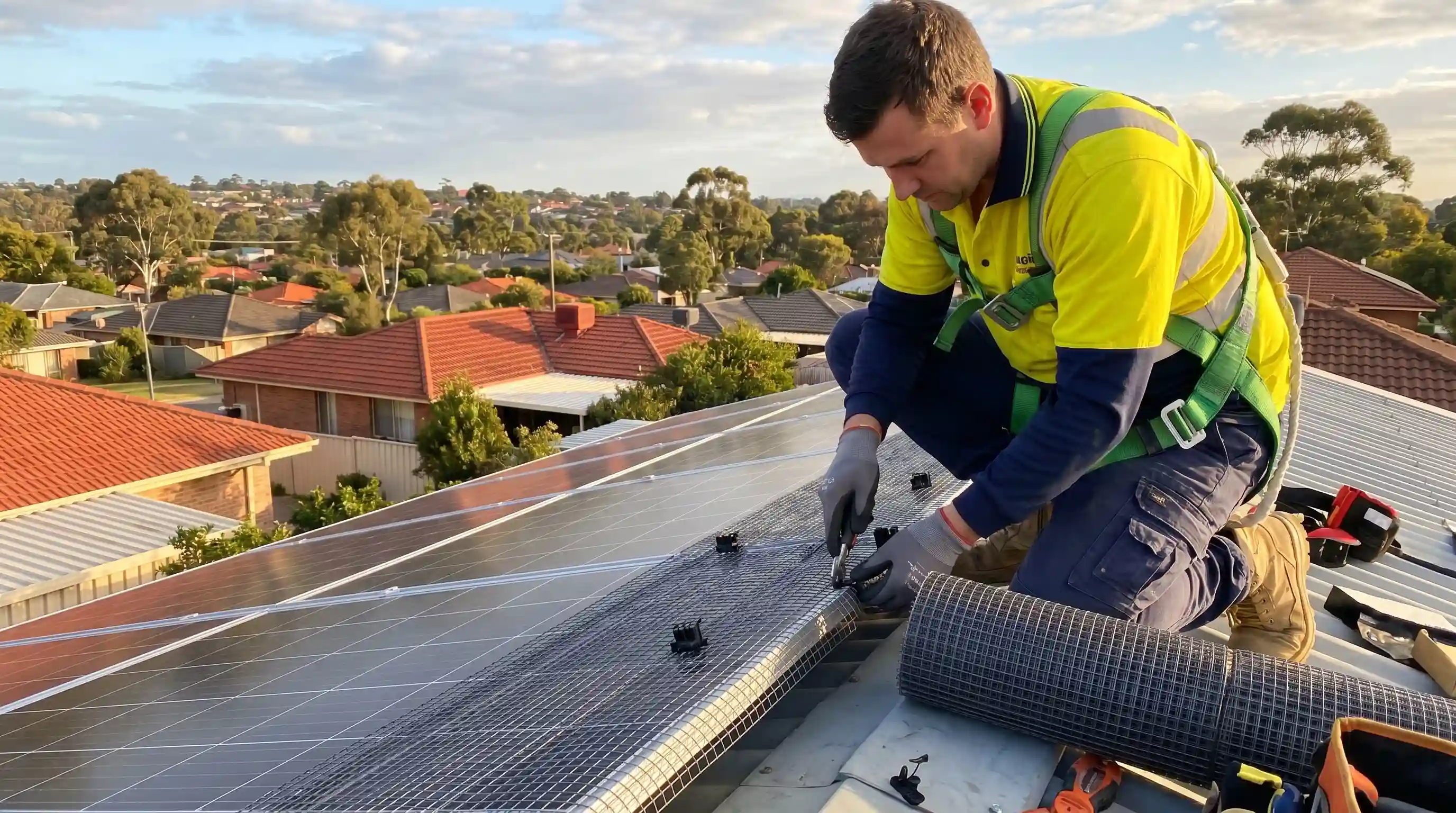
- 06Sealing. Mesh is fitted around the full perimeter of the array using clips that grip the panel frame, with no drilling into panels, frames or roof sheets.
- 07Photographic record. Before and after images of the cavity, ideally including the corners, so you can see what was actually there.
On the dust
Dried droppings are not just unpleasant. NSW Health's psittacosis fact sheet notes that infection usually occurs when a person inhales the bacteria from dried droppings, mucous and feather dust from infected birds, and that contact with wild birds and their droppings can cause infection. Outbreaks have been linked to breathing in dust stirred up after wild bird droppings were disturbed. That is a direct argument against dry-sweeping a fouled array on a windy day, and an argument for respiratory protection during clean-out. It is also why "just hose it off" is the wrong instinct.
Once the cavity is clear and sealed, the mesh detail itself matters for how long the fix lasts. Mesh grades, clip systems and DIY kits are compared in our companion guide: how mesh grades and fixings compare.
What removal costs when birds are already in
Two separate things are being priced, and a good quote shows both.
Proofing (the mesh)
Priced by the linear metre of array perimeter, not by panel count, because the job is sealing the edge rather than covering the panels. Published Australian rates in 2026 sit in a band of roughly $17 to $30 per linear metre including installation, with GST treatment varying between operators. A typical residential array runs somewhere between 10 and 20 linear metres of perimeter, which is why most straightforward residential jobs land in the hundreds rather than the thousands.
Removal and decontamination
The variable. It depends on how long the birds have been there, how much material is under the array, whether gutters need clearing, whether mite treatment is required, and how hard the roof is to work on. A single-storey tiled roof with one recent nest is a different job from a two-storey array that has held a colony for three seasons.
Our published Sydney range
Ranges are indicative. Every quote is written after a free site assessment and itemises clean-out separately from mesh.
Three things to check on any quote you receive
- Does it itemise clean-out and disinfection separately from the mesh, or bundle them? Either is fine, but you should be able to see it.
- Does it state the mesh grade and the fixing method? "Marine grade" on its own is marketing language, not a specification. In coastal Sydney the relevant answer is 316 stainless.
- Does it cover gutter clearing, or will that be a second trade and a second visit?
For a full breakdown of what proofing itself costs and how long it lasts, see the bird proofing cost guide, or go straight to the solar panel bird proofing service to book.
When it becomes an electrician's job, not a pest job
Nesting material sits against DC cabling, and pigeons peck. If clean-out reveals damaged cable sheathing, chewed insulation, dislodged MC4 connectors or corroded earth straps, that is outside a pest technician's scope and outside a solar cleaner's scope.
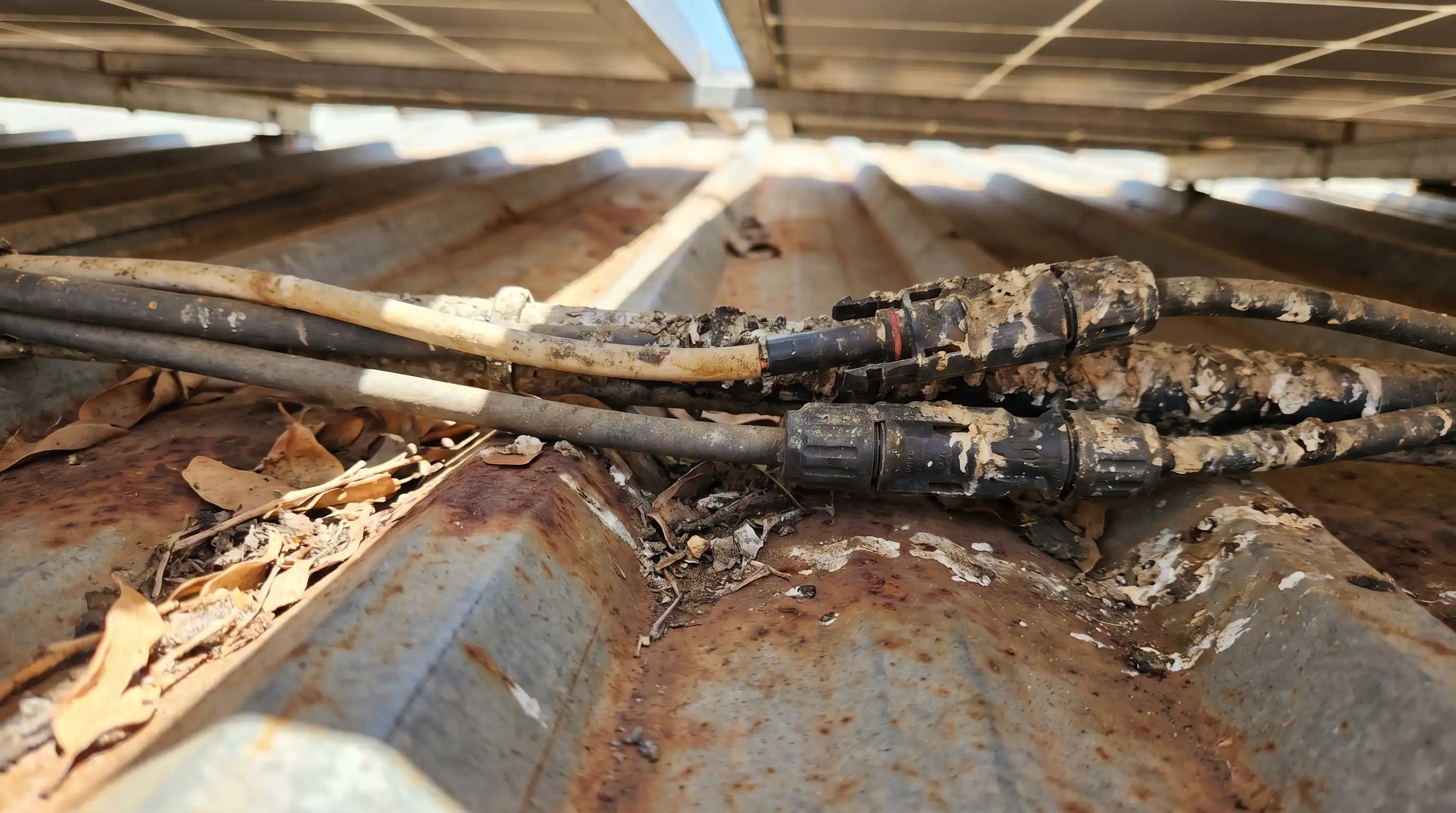
Rooftop solar DC wiring stays live in daylight even when the inverter is off. Repairs and reconnections are work for a licensed electrician, and for warranty purposes usually a Clean Energy Council accredited installer. A pest operator should photograph what they find, tell you plainly, and stop. If yours offers to "tidy up" damaged wiring, decline and call your installer.
Find an accredited installer through the Clean Energy Council.
Four mistakes that make an active infestation worse
Sealing over the nest
Mesh goes on, the material stays underneath, and you now have a sealed cavity full of dropping dust, decaying nest material and mites, with no access. This is the most expensive mistake on the list because fixing it means removing the mesh you just paid for.
Clearing without treating
The nest goes in the bin, the mites move into the ceiling, and three weeks later you are dealing with bites and a second problem you did not connect to the first one.
Deterrents first
Plastic owls, reflective tape, ultrasonic emitters and gels have limited effect on birds that have already chosen a nesting site and will return to it. Spending on them delays the actual fix while the material and droppings continue to accumulate.
Dry sweeping
Disturbing dried droppings without respiratory protection is the exact exposure route NSW Health describes for psittacosis. If you are on the roof at all, at minimum wear a fitted mask and gloves, and do not do it on a windy day.
Timing: what changes through the Sydney year
Feral pigeons breed through the year in urban Sydney, so there is no month where the problem reliably resolves itself. What does shift by season is the risk profile of the removal work.
| Period | What is different |
|---|---|
| Late winter into spring (roughly July onward) | Main breeding season is under way. Active nests are more likely, which makes species identification and the active-nest check more consequential. |
| Spring and early summer | Bird mites are at their most active, according to SA Health. Clean-out and treatment need to be done together, not in separate visits weeks apart. |
| Late summer and autumn | Often the most straightforward window for a clear-and-seal, though this depends entirely on what is actually up there rather than the calendar. |
The practical takeaway is not "wait for the right season". It is that an infestation found in spring needs the mite treatment planned into the job, and one found in autumn may be a simpler visit. Waiting does not help either way. Nest material and droppings accumulate, and pigeons return to the same site season after season once they have bred there successfully. For how seasonality affects pest work generally, see our seasonal pest control guide.
What to ask before you book
Any competent Sydney operator will answer all eight without hesitating.
- Which species is under my array, and how did you identify it?
- Is the nest active, and how are you handling that?
- Is nest removal, dropping removal, disinfection and mite treatment included, or quoted separately?
- What mesh grade and what fixing method, and will you confirm in writing that nothing is drilled into panels, frames or roof sheets?
- Will you clear the gutters and downpipes in the same visit?
- Will I get before and after photos of the cavity?
- What is covered by the workmanship warranty, and for how long?
- Are your technicians licensed for pest management in NSW, insured, and certified to work at heights?
Frequently asked questions
Tap a question to expand the answer.
Sources
- NSW Department of Climate Change, Energy, the Environment and Water, Protected species
- NSW Government, Code of Practice for injured, sick and orphaned native birds (2022)
- NSW Government, Prevention of Cruelty to Animals Act 1979
- NSW Health, Psittacosis (Ornithosis) fact sheet
- SA Health, Bird mites: prevention and treatment
- SA Health, Feral pigeons: management and control
- Bathurst Regional Council, Pest bird fact sheet: feral pigeon
Published 2 August 2026. Market pricing is time-sensitive and reviewed periodically. Legal information is general in nature and current at the date of publication; it is not legal advice.
Birds already under your panels?
We inspect, identify the species, clear and decontaminate, treat for mites, and seal the array in one visit across Greater Sydney. Free site assessment, no obligation, written itemised quote.
Sydney suburbs we cover for solar bird removal
Same-day and next-day roof work across Greater Sydney, including coastal suburbs where 316 stainless mesh matters most.